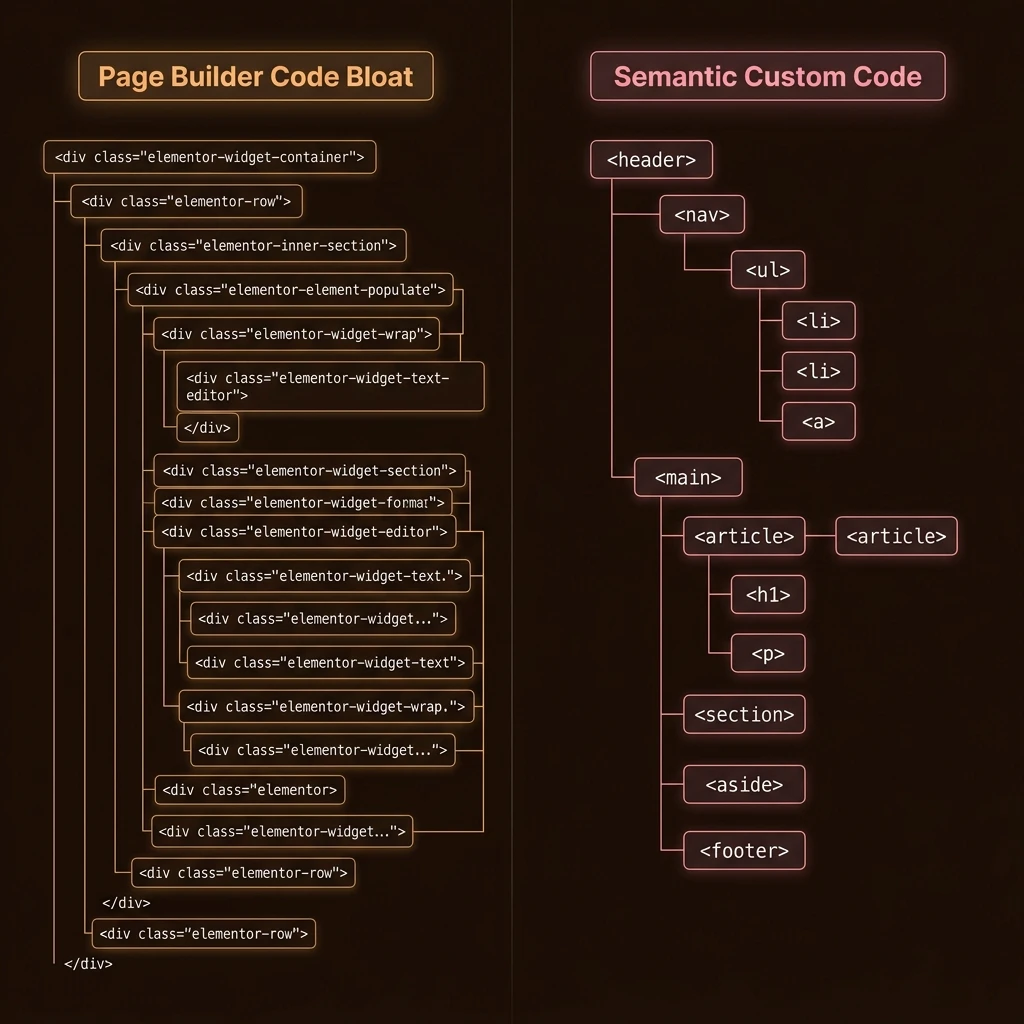
Websites built with WordPress page builders compile up to fifteen layers of nested layout containers for a single block of text, swelling DOM sizes and blocking mobile browsers. By discarding these page builder overheads in favor of bespoke React components, you ensure faster rendering speeds and superior mobile search visibility.
WordPress is the most common CMS, but its dependence on visual editors (like Elementor, Divi, or WPBakery) has turned it into a performance bottleneck for modern businesses. Visual builders allow non-developers to arrange components, but this visual convenience results in messy, bloated code structures. A single text element on a builder page generates nested layers of layout divs, styling wrappers, and duplicate script blocks that slow down load times on mobile devices.
1. The Technical Overhead: Visual Builders vs. Bespoke Code
Visual page builders translate editor choices into database queries and inline CSS styling classes. The resulting code is bloated and hard for search engines to scan:
<!-- Typical bloated page builder structure for a simple heading -->
<div class="elementor-element elementor-widget" data-element_type="widget">
  <div class="elementor-widget-container">
    <div class="elementor-heading-title-wrapper">
      <h2 class="elementor-heading-title elementor-size-default">
        Our Services
      </h2>
    </div>
  </div>
</div>

<!-- Bespoke semantic custom HTML equivalent -->
<h2>Our Services</h2>
The page builder code is five times larger than the semantic custom markup. When applied across an entire page with hundreds of components, the DOM size climbs past 2,000 nodes, exhausting mobile CPU capacity during parsing and layout layout cycles. Custom websites built on clean semantic templates load only the required DOM markup, keeping bundle sizes light.
2. Performance & Maintenance Trade-Offs
Choosing between custom builds and template-driven CMS solutions involves balancing speed, flexibility, and maintenance overheads:
Vulnerability & Plugin Overhead
WordPress installations require multiple plugins for simple features like caching, image optimization, or forms. Every plugin introduces potential security vulnerabilities and compatibility conflicts during updates. A custom React website compiled with Vite requires zero plugins; features are engineered directly into the application logic, keeping the site secure and stable.
Server Caching Limitations
WordPress relies on database lookups to compile pages, requiring dynamic server execution on every visit. While caching plugins can help, they add complexity and can fail under high traffic. Bespoke static sites (SSG) pre-render directly into HTML files at build time, serving visitors instantly from edge CDNs like Cloudflare or Vercel.
Comparison Matrix: Custom React vs. WordPress
- DOM Size: React (~400 nodes) vs. WordPress Builder (>1800 nodes).
- Plugins Needed: React (0) vs. WordPress (15-30).
- Hosting Location: React (Global CDN Edge) vs. WordPress (Database server).
- Mobile Load Speeds: React (<1.0s) vs. WordPress Builder (3s - 7s).
3. Choosing the Right Platform: Decision Tree
Use this decision framework to align your project requirements with the right development path:
Is your primary goal conversion speed and organic search rankings?
  ├── YES ──> Choose Custom React / Vite (Edge Hosted)
  └── NO
       └── Do you require frequent design edits by non-technical staff?
            ├── YES ──> WordPress (Gutenberg / Blocks — limit plugins)
            └── NO  ──> Headless CMS with custom frontend
For B2B SaaS, startups, and lead generation portfolios, custom website code is the clear choice. We demonstrated this conversion boost in our My Design Academia Case Study, where transitioning from a slow WordPress site led to a 150% increase in student leads.
At Pizzascript, we build custom sites that load instantly and convert visitors. Learn more about our approach on our Custom Website Development Service page or contact us to discuss your project.